
Top AI Citation Tracking Tools for SaaS: Get Cited by ChatGPT (2026)
Discover the best AI citation tracking tools for SaaS brands in 2026. Learn data-backed strategies to boost your brand's visibility in ChatGPT, Perplexity, and Google AI Overviews. Optimize for AEO & GEO.
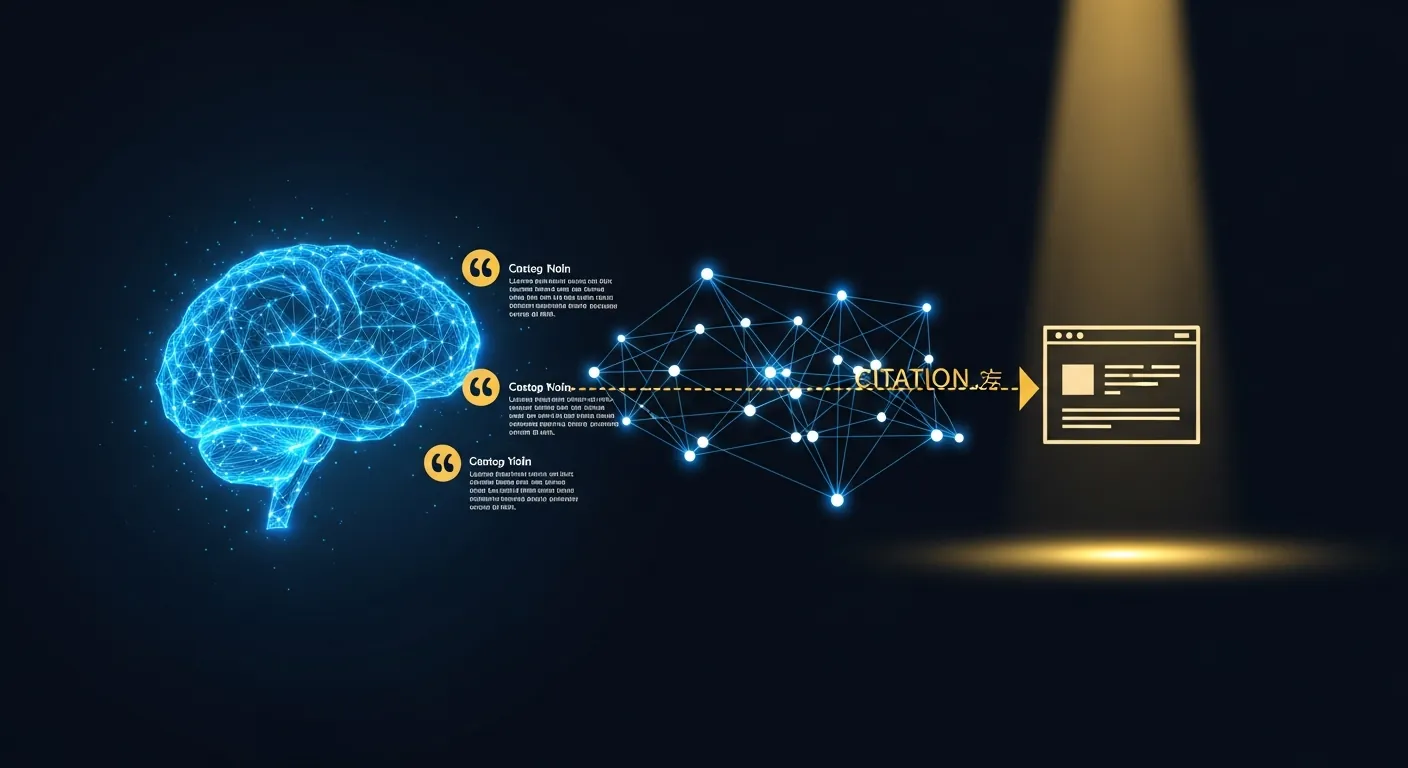
The search landscape has fundamentally shifted. Today, 73% of B2B buyers use AI tools like ChatGPT and Perplexity during their research process. For a SaaS company, being invisible in these AI-generated answers means losing highly qualified, lower-funnel leads before they ever reach your website.
Even more importantly, AI-referred traffic represents a massive opportunity: visitors arriving via AI citations convert at 4.4x higher rates than traditional organic search and bounce 27% less.
To capture this demand, SaaS marketers must pivot from traditional Search Engine Optimization (SEO) to Answer Engine Optimization (AEO) and Generative Engine Optimization (GEO). This guide breaks down the best AI citation tracking tools for SaaS brands and the exact, data-backed content strategies required to get cited.
Short on time? Here’s the 7-minute video version.
How to Track If AI Is Citing Your Brand in Search Results
Before you can improve your AI visibility, you need to know where you stand. Traditional SEO tools measure blue links, but they are blind to the new battleground: generative answers. AI rank trackers act as an “MRI scanner” for your brand inside those answers, showing you exactly which prompts mention you, which mention your competitors, and where you are invisible.
Here is a breakdown of the top platforms specifically suited for SaaS companies looking to measure and grow their AI Share of Voice (SoV):
| Tool Name | Best For | Starting Price | Key Differentiator |
|---|---|---|---|
| Legible | End-to-End AI Visibility & Optimization | Free tier available | The only platform that combines real-time AI crawler monitoring, auto-generated llms.txt, and one-click CMS integration (Webflow, WordPress, Drupal) — so you control what AI sees before you even start tracking citations. |
| Siftly | Comprehensive GEO Strategy | Custom / Enterprise | Delivers prescriptive optimization guidance; users report a 1500% increase in AI mentions within 2 weeks. |
| AIclicks.io | Actionable Content Workflows | $59/month | Tracks prompt-level visibility, identifies content gaps, and integrates directly with GA4 for traffic attribution. |
| Peec AI | Mid-Market SaaS Teams | $95/month | Marketer-friendly dashboards with unlimited seats and exports; focuses on visibility share and sentiment. |
| Scrunch AI | Narrative & Reputation Control | $250/month | Specializes in finding and fixing AI misinformation, such as outdated SaaS pricing or incorrect features. |
| Profound | Enterprise-Scale Tracking | ~$499/month | Daily tracking across a massive array of models (ChatGPT, Perplexity, Gemini, Copilot, Grok) with API access. |
How to choose: Most SaaS teams need two things — a way to optimize what AI crawlers see and a way to track where your brand appears. Tracking tools like Siftly and Peec AI tell you where you stand, but they cannot fix your underlying AI crawlability. Legible handles the optimization layer: converting your pages into AI-readable Markdown that is 80% lighter, managing your 16 AI signals, and auto-generating your llms.txt. The ideal setup pairs Legible for optimization with a tracker like Siftly or AIclicks.io for measurement.
How to Make Your Website Show Up in ChatGPT and Perplexity Answers
A critical mistake SaaS marketers make is treating all AI search engines the same. If you want your website to appear in ChatGPT answers and Perplexity answers, you need to understand that these are fundamentally different systems with different source preferences. There is only an 11% citation overlap between the two. They want entirely different things:
ChatGPT prefers encyclopedic, factual data directly from the source. It heavily cites Wikipedia (47.9% of top-10 citations) and favors objective brand domains over third-party commentary. To appear here, your site must be technically crawlable by OAI-SearchBot — something you can verify instantly using Legible’s live crawler dashboard, which tracks GPTBot activity alongside 20+ other AI systems in real time.
Perplexity values community-validated, real-time insights. Reddit accounts for 46.7% of Perplexity’s top citations, meaning authentic participation in communities is vital for visibility here.
Google AI Overviews (AIO) heavily favors multimodal content and traditional SEO. YouTube makes up 23.3% of citations, and 92.36% of AI Overview citations come from domains that already rank in the top 10 of standard search results.
The takeaway: you need a different playbook for each engine — and the technical foundation to ensure all three can actually read your content.
5 Data-Backed Content Strategies to Get Cited by AI
Generative engines do not read like humans; they extract modular, structured facts. To win citations, implement these 5 proven AEO strategies:
1. Front-Load “Answer Capsules” and Structure Your Formatting
AI models look for immediate, clear answers to extract.
The 40-60 Word Rule: Place your core answer in a 40-60 word “lead paragraph” immediately following a question-based H2 or H3 heading. Research shows 44.2% of AI-cited content places the core answer in the first paragraph.
Section Length: Keep supporting sections between 120-180 words. Sections of this length receive 70% more citations than those under 50 words, as they are optimal for clean AI extraction.
Use Comparison Tables: Content featuring comparison tables earns 2.5x more citations than text-only equivalents. Ensure your tables have clear, descriptive column headers.
2. Embed Verifiable Statistics and High Entity Density
Polished marketing fluff gets ignored by LLMs. AI models seek out objective facts, proprietary data, and named experts to satisfy Google’s E-E-A-T (Experience, Expertise, Authoritativeness, Trustworthiness) requirements.
- Adding statistics with methodology notes and proper source citations can boost AI citation rates by up to 40%.
- Content with verifiable claims receives 44% more citations than unsubstantiated material.
- Increase your entity density by naming specific frameworks, tools, and researchers. Cited content has a 20.6% higher proper-noun density.
3. Signal Extreme Content Freshness
Recency bias in AI models is massive, particularly for real-time engines like Perplexity. AI assistants prefer cited content that is, on average, 25.7% newer than traditional search results.
- 76.4% of AI-cited pages were updated within the last 30 days.
- Substantive content updates earn 3.8x more citations than minor cosmetic tweaks.
- Simply adding a visible “Last Updated” timestamp can lift your citation rates by 47% and boost AI ranking positions by up to 95 places.
This is where a CMS integration becomes critical. Every time you update a page in Webflow, WordPress, or Drupal, Legible auto-syncs your AI-optimized content — so the freshest version of your page is always what AI crawlers see, without any manual export step.
4. Leverage Third-Party Validation (Reddit & YouTube)
You cannot manufacture all your authority on your own domain. Brands are 6.5x more likely to be cited by AI engines through third-party mentions than through their own website alone.
Reddit Strategy: Because Reddit powers over 40% of Perplexity citations and 21% of Google AI Overview citations, participating authentically in B2B subreddits is a primary driver of visibility.
YouTube Strategy: YouTube accounts for 39.2% of all social citations in Google AI Overviews. Publishing technical walkthroughs and video explainers feeds directly into multimodal AI citation pools.
5. Ensure Flawless Technical AI Crawlability
If AI bots cannot access your content, you cannot be cited. Up to 69% of AI crawlers cannot execute client-side JavaScript, meaning your core content must be delivered in the initial HTML response (SSR/SSG).
Schema Markup: Implement robust structured data (FAQPage, HowTo, Article, and Organization schema) to help AI parse your content.
Crawl Directives: Ensure your robots.txt and llms.txt files allow access to AI search bots like OAI-SearchBot while blocking unwanted training scrapers. Manually building and maintaining these directives across dozens of AI bots is error-prone — Legible’s AI access controls let you set visibility presets (Conservative, Balanced, or Open) that automatically configure the right directives for each crawler, so you stay visible to search bots without exposing your content to training scrapers.
AI-Ready Content Delivery: Even if your pages are server-rendered, AI crawlers receive raw HTML — not the polished version humans see. Legible converts your pages into clean Markdown that is 80% lighter and purpose-built for AI extraction, ensuring your structured data, answer capsules, and comparison tables are interpreted correctly.
Bringing It All Together: A Practical Checklist
Getting your brand cited by ChatGPT is not a single tactic — it is a system. Here is how the pieces fit:
| Layer | What It Does | Tool / Approach |
|---|---|---|
| Technical Foundation | Ensures AI crawlers can read your site | Legible — AI-ready Markdown, llms.txt, crawler monitoring |
| Content Optimization | Structures pages for AI extraction | Answer capsules, comparison tables, entity density |
| Freshness Signal | Keeps content current for recency bias | CMS auto-sync via Legible + editorial calendar |
| Third-Party Authority | Builds citations from trusted sources | Reddit participation, YouTube explainers, guest posts |
| Tracking & Measurement | Monitors AI Share of Voice over time | Siftly, AIclicks.io, Peec AI, or Profound |
| AI Agent Integration | Feeds your content into support chatbots & RAG pipelines | Legible Connect for Intercom, Zendesk, custom APIs |
Most SaaS teams start by getting the technical layer right — if AI cannot crawl you, nothing else matters. Start with Legible’s free tier to see exactly which AI systems are visiting your site today, then layer on content strategy and tracking as you scale.
Frequently Asked Questions
How do I get my website recommended by AI search engines?
AI search engines like ChatGPT, Perplexity, and Google AI Overviews recommend websites that meet three criteria: the content is technically crawlable by AI bots, the information is structured for easy extraction (answer capsules, tables, schema markup), and the brand has authority signals from third-party sources like Reddit, YouTube, and industry publications. Start by ensuring AI crawlers can actually access your site — Legible’s free crawler dashboard shows you which AI systems are visiting your pages and whether they can read your content.
Can I track if AI is already citing my brand?
Yes. A new category of AI citation tracking tools now exists specifically for this purpose. Platforms like Siftly, Peec AI, and Profound monitor whether your brand appears in AI-generated answers across ChatGPT, Perplexity, Gemini, and Google AI Overviews. They show your AI Share of Voice relative to competitors, which prompts trigger your brand, and where you are missing. See the full comparison table above for pricing and feature breakdowns.
What is the difference between SEO, AEO, and GEO?
SEO (Search Engine Optimization) targets traditional blue-link rankings on Google. AEO (Answer Engine Optimization) focuses on getting your content selected as the direct answer in featured snippets and AI-generated responses. GEO (Generative Engine Optimization) is the broadest discipline — it encompasses everything required to make your brand visible across all generative AI systems, from technical crawlability and llms.txt configuration to content structure and third-party authority building.
Do I need separate strategies for ChatGPT and Perplexity?
Yes. ChatGPT and Perplexity share only an 11% citation overlap. ChatGPT favors authoritative source domains and encyclopedic content, while Perplexity leans heavily on Reddit and community-validated insights. Google AI Overviews are a third system entirely, favoring sites that already rank in traditional search and have YouTube or multimodal content. The breakdown above covers what each engine prioritizes and how to optimize for all three simultaneously.
Recommended Next: More Guides in This Series
Looking to go deeper on a specific topic? These companion guides cover the areas we touched on above in dedicated, step-by-step detail:
| Guide Topic | Target Keyword | Status |
|---|---|---|
| How to Set Up llms.txt on Webflow Without Coding | how to set up llms.txt on webflow without coding | Live |
| Automated llms.txt Generator for WordPress | automated llms.txt generator for wordpress | Live |
| AI Search Optimization Tools for Small Business | ai search optimization platform for small business + generative engine optimization tool for small brands | Live |
| How to Optimize Your Website for AI Crawlers | optimize website content for ai crawlers automatically | Live |
Related Reading
- The AI Gold Rush Is Breaking Your Content
- Legible vs. Cloudflare Markdown for Agents
- Frequently Asked Questions About GEO & AI Search
- Implementation Docs & Getting Started
- How to Set Up llms.txt on Webflow Without Coding
- Automated llms.txt Generators for WordPress
- AI Search Optimization Tools for Small Business
- How to Optimize Your Website for AI Crawlers
- Best Otterly AI Alternative for AI Visibility
- Best Surfer SEO Alternative for AI Visibility
Make your site AI-ready
Join leading companies making their content perfectly legible to AI agents and LLMs.
Get started for freeRelated posts
Optimize for AI Crawlers (2026): Guide to GPTBot, ChatGPT & More
Ensure AI crawlers like GPTBot & ChatGPT can read your site. Learn to fix JavaScript issues, manage crawler access, and optimize content for AI search in 2026. Get cited by AI.
Read more GEOTop AI SEO & GEO Tools for Small Business (2026)
Discover the leading AI SEO and GEO tools for small businesses in 2026. Compare features, pricing, and find the perfect platform to boost your brand's visibility in AI search results.
Read more llms.txtTop WordPress llms.txt Generators: Free Plugins & SaaS (2026)
Discover the best automated llms.txt generators for WordPress in 2026. Compare free plugins, SaaS platforms, and web tools to optimize your site for AI crawlers. Find the perfect fit for your needs and budget.
Read more