
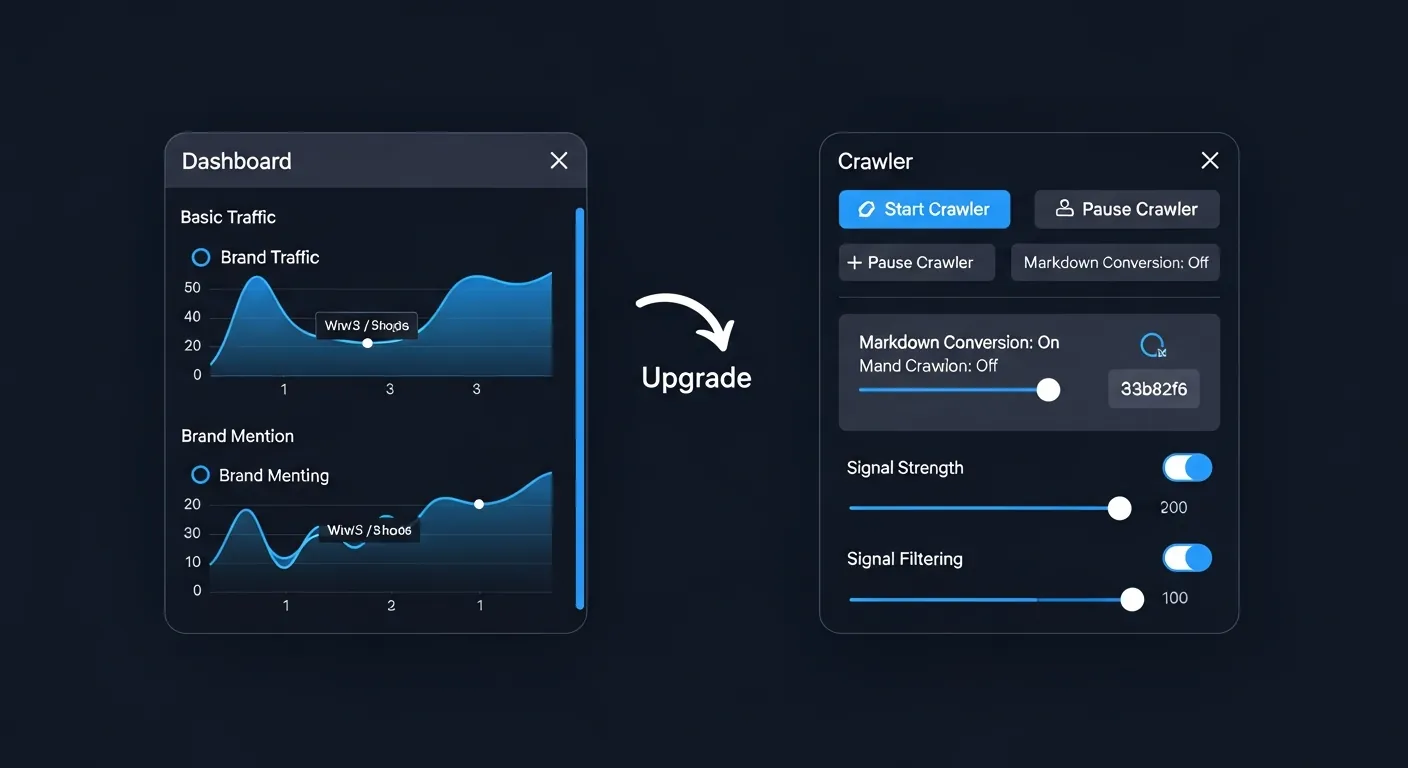
Otterly.AI does one thing and does it well: it monitors where your brand appears in AI-generated answers across ChatGPT, Perplexity, and Google AI Overviews. For many teams, that is the right starting point. You cannot improve what you cannot measure.
But monitoring has a ceiling. Otterly shows you the score — it cannot change it. If the dashboard tells you that your brand is invisible to ChatGPT, Otterly cannot fix the reason why. It cannot convert your pages to AI-readable formats, manage which crawlers access your site, or keep your AI signals in sync as your content changes.
That gap — between knowing your AI visibility and controlling it — is where most teams start looking for an alternative.
This page breaks down where Otterly fits, where it falls short, and which tools fill the gaps depending on what you actually need.
What Otterly AI Does Well
Credit where it is due. Otterly is the most beginner-friendly AI visibility tracker on the market:
5-minute setup. Connect your brand, enter a few search prompts, and Otterly starts monitoring how AI engines respond. No technical configuration required.
Automated weekly reports. You get a recurring summary of where your brand was mentioned, which competitors appeared, and how your visibility is trending. Useful for stakeholders who need a regular pulse check.
Multi-platform tracking. Otterly monitors ChatGPT, Perplexity, Google AI Overviews, and Bing Copilot. Gemini and Google AI Mode are available as add-ons.
Accessible entry price. The Lite plan starts at $29/month for 15 search prompts — enough to establish a baseline for a single brand or product category.
Where Otterly Falls Short
The limitations become clear once you move past the monitoring stage and want to actually improve your AI visibility:
Monitoring only, no optimization. This is the most common complaint in user reviews. Otterly tells you where you stand but provides no specific guidance on how to improve. As one G2 reviewer put it: you get the report, but you miss a clear direction on what to do next. There is no content optimization, no technical audit, no crawler management.
No visibility into actual AI crawler activity. Otterly tracks what AI says about you, but it cannot show you which AI crawlers are visiting your site, how often, or whether they can even read your content. You are seeing the output without understanding the input.
Data can lag up to 7 days. Monitoring runs on a schedule, not in real time. For brands responding to PR situations, product launches, or competitive moves, a week-old snapshot may already be stale.
Prompt-based pricing scales steeply. The Lite plan covers 15 prompts. The jump to Standard (100 prompts) is $189/month — a 6.5x price increase. For small businesses tracking multiple product lines or competitor sets, costs escalate quickly.
Claude is missing. As of early 2026, Otterly does not track Anthropic's Claude — one of the fastest-growing AI assistants in the market.
No crawler access controls. Otterly cannot distinguish between AI search bots (which drive citations and traffic) and AI training scrapers (which consume your content without attribution). You have no way to manage this through the platform.
Legible: The Alternative That Controls What AI Sees
Legible approaches AI visibility from the opposite direction. Instead of monitoring AI outputs after the fact, it manages the inputs — controlling how AI crawlers read, parse, and cache your content before they generate answers.
| Otterly.AI | Legible | |
|---|---|---|
| Core function | Monitors brand mentions in AI answers | Optimizes how AI crawlers read your site |
| AI crawler monitoring | No — tracks AI outputs, not crawler visits | Yes — live dashboard tracking 20+ AI systems |
| Content optimization | No | Yes — converts HTML to Markdown (80% lighter) |
| llms.txt generation | No | Yes — auto-generated, auto-synced with CMS |
| Crawler access controls | No | Yes — visibility presets (Conservative, Balanced, Open) |
| AI signals managed | 0 (monitoring only) | 16 (llms.txt, JSON-LD, meta tags, cache headers, etc.) |
| CMS auto-sync | N/A | Yes — WordPress, Webflow, Drupal |
| Chatbot deployment | No | Yes — Legible Connect for Intercom, Zendesk, RAG APIs |
| Claude tracking | No | Yes |
| Data freshness | Up to 7-day lag | Real-time crawler monitoring |
| Free tier | No (starts at $29/mo) | Yes |
They solve different problems. Otterly answers “where does my brand appear in AI answers?” Legible answers “can AI crawlers read my site, and what do they see when they do?” For most teams, the second question needs to be answered first — if AI cannot read your content, monitoring an empty dashboard is a waste of money.
They can also work together. A common setup is Legible for the optimization layer (ensuring AI crawlers receive clean, structured content) paired with Otterly or another tracker for the monitoring layer (measuring how that optimization translates into citations). Legible handles the inputs; a tracker handles the outputs.
Other Otterly AI Alternatives Worth Considering
If your primary need is monitoring rather than optimization, here are the strongest alternatives in the tracking category:
Rankscale.ai — $20/month
The most affordable dedicated tracker. Rankscale excels at citation source mapping — it shows you not just that your brand was mentioned, but which specific third-party sites AI models used as sources. The credit-based pricing model keeps costs predictable for small teams testing GEO before committing to larger platforms.
Choose Rankscale over Otterly if: you care more about understanding why AI cites you (source analysis) than high-level brand tracking.
Geoptie — $49/month
The best all-in-one GEO platform at an accessible price point. Geoptie combines visibility tracking across ChatGPT, Claude, Perplexity, and Google AI Overviews with a content studio, GEO audit tool, and keyword finder. It is the closest thing to Otterly's monitoring plus Legible's optimization in a single tool, though it does not offer the same depth of technical crawler management.
Choose Geoptie over Otterly if: you want tracking and content optimization guidance in one dashboard without managing separate tools.
Peec AI — $89/month
Peec focuses on enterprise-grade visibility tracking with sentiment analysis, 115+ language support, and unlimited team seats. Its dashboards are more visual and detailed than Otterly's, making it a better fit for larger teams that need to present AI visibility data to stakeholders.
Choose Peec AI over Otterly if: you need sentiment tracking, multilingual coverage, or presentation-ready dashboards.
Profound — ~$499/month
The enterprise leader in AI visibility tracking. Profound monitors 10+ AI platforms (including Claude, Grok, and DeepSeek), provides prompt volume data showing actual search demand, and offers API access for custom integrations. It is the tracker to choose when you need the broadest coverage and deepest data — but at a significant price premium.
Choose Profound over Otterly if: you are an enterprise team that needs the most comprehensive AI tracking data available and can justify the budget.
The Right Combination for Small Businesses
Most small businesses do not need to choose a single tool. The AI visibility stack works in layers:
| Layer | What It Does | Recommended Tool |
|---|---|---|
| Technical foundation | Ensures AI crawlers can read your site | Legible (free tier) |
| Visibility tracking | Monitors where your brand appears in AI answers | Otterly.AI ($29/mo) or Rankscale ($20/mo) |
| Content optimization | Structures content for AI extraction | Geoptie ($49/mo) or Surfer SEO ($49–99/mo) |
Start with the technical foundation. If AI crawlers cannot read your site, investing in a tracking tool will only confirm that you are invisible — without giving you the means to fix it. Legible's free tier shows you which AI systems are visiting your site today. Once you know your content is being delivered correctly, add a monitoring tool to measure the results.
For the complete comparison of tools at every price point, see our full guide: AI Search Optimization Tools for Small Business.
Frequently Asked Questions
Can I use Otterly AI and Legible together?
Yes, and this is a common approach. Legible handles the optimization layer — converting your content to AI-readable formats, managing crawler access, and keeping your AI signals in sync. Otterly handles the monitoring layer — tracking where your brand appears in AI answers over time. Together, they cover the full cycle: optimize what AI crawlers see, then measure the results.
Is Otterly AI worth it for a small business?
At $29/month for 15 prompts, Otterly is a reasonable investment for establishing a baseline — learning whether AI engines mention your brand at all, and for which topics. However, if the answer is “no, you are invisible,” Otterly cannot help you fix that. You would need an optimization tool like Legible or a content platform like Geoptie to address the underlying causes.
What is the biggest difference between Legible and Otterly?
Otterly monitors AI outputs — what AI says about you in its answers. Legible manages AI inputs — what AI crawlers see when they visit your site. Otterly is a dashboard. Legible is infrastructure. Most teams need both layers eventually, but the infrastructure layer needs to come first.
Does Legible track brand mentions like Otterly does?
Legible tracks AI crawler activity on your site — which bots visit, how often, and what they read — but it does not monitor what AI models say about your brand in their answers. That is the monitoring layer, which tools like Otterly, Rankscale, and Peec AI handle. Legible focuses on the optimization side: ensuring what AI crawlers find on your site is clean, structured, and working in your favor.
Related Reading
- Best Tool to Get Your Brand Cited by ChatGPT
- AI Search Optimization Tools for Small Business
- How to Optimize Your Website for AI Crawlers Automatically
- What is llms.txt and Why It Matters
- Legible vs. Cloudflare Markdown for Agents
- Best Surfer SEO Alternative for AI Visibility
- Implementation Docs & Getting Started